


What responsibility do we have for our ideas once they leave us?
The assignment of moral blame usually stops close to the source since true attribution is hard, e.g. how much responsibility does Friedrich Nietzsche have for the Nazis? Open question, though it doesn’t strike most of us as fair that we have to game out who our ideas might influence and how decades or centuries ahead of time.1
Praise for good influence is easier. Attribution is likely just as challenging, but the stakes are lower. Reminds me of this old chestnut:
“Success has many fathers. Failure is an orphan.”
— lots of people, maybe JFK quoting someone who may or not be Tacitus
When ideas actually have consequences
I remember being a young adult libertarian. I really felt like I was on to something. I was fascinated by using deductive logic to figure out the foundational ethic of humanity, something like:
each person owns their own body
they own what they use their body to create
therefore, they create a natural property right in that which they transform
It was actually surprisingly difficult to write that. I didn’t write it as carefully as I once might have, primarily because I don’t think it’s the correct starting point for a political ontology and ethic.2
Once you start from this spot within the deontological and natural rights orientation, much of human society as currently organized becomes impossible. It leads one to taking the idea of consent seriously with regard to government. The consent of the governed is a beautiful idea, especially when contrasted with rival principles like “might makes right” or “the divine right of kings” (though perhaps I repeat myself), but as David Hume argued very convincingly—explicit consent of everyone under a government is impossible, and implicit consent is equally absurd…
“We may as well assert that a man, by remaining in a vessel, freely consents to the dominion of the master; though he was carried on board while asleep, and must leap into the ocean and perish, the moment he leaves her.”
—David Hume, “Of the Original Contract” (1748)
Hume’s argument is that Enlightenment attempts to find a rational order based upon consent were practically impossible, but there still may be good reasons to trust established order and tradition. As far as I understand the conservative tradition, this is one of their best arguments, even if I have some Rousseau and Paine jeering at this idea from the sidelines. We know the world to be socially constructed, but that doesn’t necessarily mean that everything socially constructed is inherently bad or should be immediately jettisoned to what we can design from first principles. In fact, many attempts to design from first principles that have a tendency to land humanity in the killing fields. Remaking the world is dangerous, and support for a liberal order which has orderly changes of government and a constitution and norms of fair play is attractive because the alternative is worse, but not can be perfectly derived from first principles like consent. That type of contractarian thinking might just be impossible.3
The original deductive approach became less attractive to me while I was doing a year of PhD coursework in political philosophy. I’ve become simpler over time. I overcomplicated things back then even in my desire to get down to what I thought was the simple aprioristic root of it all. My politics now point to The Sermon on the Mount, in ways both halting and ecstatic. But I know that if I get too far away from the actual literal suffering of real humans in front of me, the cerebral part of me can grab the steering wheel and start thinking those abstract thoughts that Wendell Berry and Hannah Arendt each eye with arsonous intent from beyond the veil. If you primarily think in terms of an ‘ism’ you are at risk of enchantment. I might be naive at this point, but it’s the Beatitudes or bust for me.
But okay, now back to those big ideas…
That three part syllogism is part of what leads people to the idea of competition for governance services and anarcho-capitalism. It disturbs me that the people who are attracted to this idea seem more attracted to their own power to the point of oligarchy and techno-feudalism, rather than giving poor people a chance at better institutions. As the world becomes more authoritarian, we see less of it cloaked in the latter and more comfort with overt displays of mastery. It may have just been there the entire time and I was a useful idiot for what the unfolding political economy would soon enable the wealthiest to pursue.
Many of my former peers from that libertarian time carry on their work. A good deal of them are still people I love and respect as smart perpendicular thinkers of high integrity. Others I hold in very low esteem. I have to ask: did I potentially influence or at the very least lend the use of libertarian ideas any moral cover to the reactionary world that was in utero? What am I to make of those who ascended in power with the cover of libertarian ideas, but ended up being a little too interested in Rhodesia, to put it euphemistically?
This section is grandiose. I was not this influential. Insofar as I was influential, I probably pushed some of the discourse towards left-libertarian ideas that I find much more humane. What if I had been more successful and made a difference though? What if being critical of centralized power gave cover to those who favor decentralism for bad ends? What responsibility would I have had for pushing out ideas that would or even just could give more leniency to monstrosity, even if my application was (I hope) sufficiently humane to be deserving of mercy?
Shifting the Overton Window: Stratospheric Aerosol Injection and Carbon Dioxide Removal
I feel this same concern for various types of Climate Intervention, Stabilization, or whatever word we choose to replace “geoengineering”. I find these naming projects to mostly be wheel spinning. Go focus test terms with normies if you are ultimately trying to convince them. Arguing inside baseball with climate nerds spills ink but is unlikely to change how we feel about what is being described. I hold neutral feelings towards basically all of these terms. If you called “Schmolar Radioactivity Managerialness”, I’d feel exactly the same as I do now.
Enough word games.
One reason why I really dislike the argument that climate interventions are going to buy us additional time for decarbonization and CDR is that our arguments will leave our mouths and laptops and if successful, ultimately find their way to the companies that need to stop producing emissions of various kinds. They will thank these climate pioneers for their bold vision of the future and likely commit to supporting climate stabilization or whatever we are calling it in three years and then do it in a way which serves their interests but not much else. It will likely be used to prolong fossil fuel infrastructure’s lifespan, slow phaseout, and delay the political coalition that needs to come together for meaningful climate policy in the US, in other countries, and as the entire world.
It isn’t moral hazard when those working seriously and in good faith on this topic suggest it, but it becomes moral hazard when those without good faith will run with the rhetoric and make some strategic investments yada yada without actually doing the hard thing. They might procrastinate further if this delays the aforementioned political coalition to reverse climate change.
Maybe it is worth doing even if climate intervention deployment slows the formation of the political coalition we need. Would I be willing to tolerate the collapse of an ice sheet over this? Those are bullet-biting decisions. I suspect the correct move would be to prevent immediate death and hardship even at great cost. Sacrificing present people against a future benefit or harm is something that should make anyone who has calculated net present value scream in despair.
Are we going to tie a binding agreement to decarbonize to climate interventions? My guess is we probably will not have the—again—durable political coalition to do this without some sort of crisis. My guess is that well-meaning people expand the Overton Window in ways that work if everyone plays by the rules and in good faith and uses the time to decarbonize. But we don’t have good evidence that it will happen in that way. So then… what are we to make of this advocacy?
And what do we make of this same dynamic at play for carbon dioxide removal? Did CDR advocacy delay climate action in any way? Would all climate activism being focused on decarbonization have been a better way to spend the last decade? It is very possible the answer is yes. If you need me, you can find me in the Slough of Despond.
The Monkey Paw
I just watched Obsession, and there is online (of course) debate about whether the film’s mechanic constitutes a true monkey paw, but good enough. The simple point of it is “be careful what you wish for.” You just might get it in a way that honors the letter of your request, but not its spirit. The ironic twist will send you away howling. Do not wish upon a monkey paw, you damned fool.
I don’t think you can say that if your ideas are pure you only have fault for your own actions. Maybe that should be the case legally (as in, could one bring a tortious claim for this), but ethically, I bet we can think up some examples where if we consider the moral content of your actions to stop at you, it will strike your moral intuition as incorrect.
Toward a McLuhanian Ethics?
Sometimes people make this case with types of money. They will say that crypto is used for bad purposes sometimes, sure, but so is cash. Should we get rid of cash? If you answer no, then you might also be pushed to answer no for crypto.
Guns don’t kill people; people kill people. It’s not an unfair thing to note that tools can serve different ends and we don’t always seek to ban tools. But we likely all have a threshold where we think the risk is too great and the reward too small to permit unlimited tool use.
One way to break this classic debate between toolwielder and tool is to pair it with Marshall McLuhan’s immortal thoughts about how “the medium is the message.” The internet doesn’t just help us communicate, it changes how we understand communication, our relationship to ourselves and others, in such grand ways that we can speak productively of a pre- and post-AOL world. If we consider tools to have some moral valence attached to them at least for the important ones (though small tools have their own ideologies embedded in them as well), and ideas are tools for ordering and making sense of an uncategorized reality, then there likely is some amount of responsibility here for promulgating ideas, shifting the Overton Window, etc. And I believe that is likely true even if one has sincerely pure intent.
The goal is to limit the eye stabbing
In this podcast episode, I discuss the Oedipus cycle. He was told he would kill his father and marry his mother. He didn’t believe it, but he did it. When he realizes it, he gauges out his own eyes in horror.
The time to game out how your ideas will affect reality is now. You don’t want to be standing beneath The Bridge on the River Kwai wondering “what have I done?!” The job is to assess this now. And to make plans as though your political rivals, maybe even your enemies, will be in charge of enacting them. If your political ideas require the very wise to enact them successfully, then you are actually not working in politics, but in spiritual renewal. You are a cleric but haven’t realized it, and the job is bigger than tech and politics, but the soul and why we can’t stand to be here in a kind and gentle way.
Too many ideas for just one post. More to come in the future…
Here’s this edition’s one and only anonymous and unverified submission that was sent in for me to read and publish:
Submission(s):
Having seen the state of CDR and CCS development so far, I don’t really believe these efforts are going to play a significant part in helping us avert the climate problem. Especially when we consider the geopolitical competition/isolation, the re-prioritization of energy security (and Europe is broke), the rise of energy-intensive AI. If we collectively couldn’t even get in the same page when times were good, I really don’t see how the next decade will be any better. However, one must do what one is here to do, regardless of the fruit of the labor. So my attitude can be described as stoically pessimistic. Neither fatalistic nor nihilistic; engaged but unsentimental. Cheers
Thanks so much for being a part of this collective art project and sharing your take on working in climate.
Sincerely,
Ross Kenyon
Thank you for listening to and reading Climate Workers Anonymous. Subscribe to Substack below, and be sure to subscribe in whichever podcast app you use. An amazing rating and review on those podcast apps does a world of good. Would you please do that for me now? Here’s Apple Podcasts, Spotify, and YouTube.
If you’d like submit your anonymous hopes, fears, or experiences to Climate Workers Anonymous, you can use this Tally survey or email climateworkersanonymous[at]protonmail.com, though I believe the Tally survey is more secure. Do not communicate anything you wouldn’t want a hacker to have access to, including an email address that could be linked to you if you email the account on Protonmail.
If one person thinks something, ten or a hundred have had the same thought and said nothing. Go first.
Anonymous by design. No email field, no sign-in, and I read every submission aloud myself so nobody ever hears your voice.
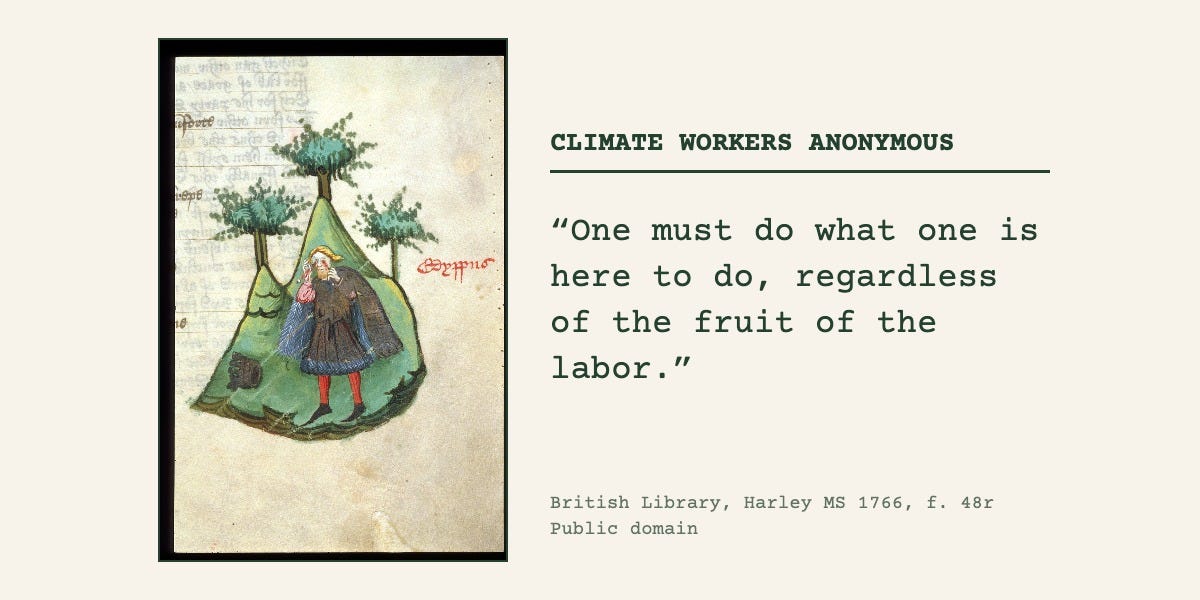
Episode art: British Library, Harley MS 1766, f. 48r. Public domain.
Full Transcript
Ross Kenyon: Hello. Thanks for listening to Climate Workers Anonymous. I’m Ross Kenyon. I’m the curator of Climate Workers Anonymous. This is a podcast and written publication where people submit their unverified and anonymous takes on working in climate.
If you’ve got something to share, something you’ve observed, something you’ve felt, follow the links in the show notes or on the Substack publication of this episode, and you can send in something that you’d like to share but also not have attached to your own name.
Telling the truth is such a simple thing to do, but simple does not mean easy.
There’s a film that I really like called Dead Man Walking. It’s from 1995. It’s about a nun who befriends someone on death row who’s been convicted of killing someone. And the film sort of sets this up that what’s gonna happen here is that she’s going to get to know the killer, take his side, understand that it’s all been a big misunderstanding, that he’s actually a good person, that this never happened, that there’s some miscarriage of justice here that a compassionate person of faith can uncover and make right.
She opposes the death penalty, as I think Christians must. And once those attempts fail, her work is about caring for this person’s soul, and noting that in order to receive forgiveness and have this be a spiritually transformative experience, it requires telling the truth about what happened and taking responsibility and owning it.
You know, if you watch movies at all, you are very well-trained to expect a deus ex machina. You expect that at the 11:59 moment, someone runs in with a telegram from the governor, staying the execution and pardoning the condemned. And that is not what happens. It’s actually a story about the spirit’s quest for redemption in the face of mortal death.
And I think for that reason it’s one of the best movies about telling the truth and its repercussions. You can contrast it with something like, uh, like Liar Liar, the other famous movie about telling the truth.
No, but I know it’s not always easy to tell the truth about our work in climate. Anything that touches your career, there’s so much stage management of what you say, how you present. Are you like a serious business person who’s gonna get some stuff done? Or are you sort of a woo-woo, touchy-feely kind of like biophilic, we’re all connected kind of person who’s not serious about business? Are you willing to cozy up to the people who write the big checks? Are you not?
How much of a respectability politics takes place inside of what is a field that I think wears its convictions pretty firmly on its sleeve? That’s what we’re here for.
I’m trying to make a space where if you’ve got something that you wanna say, you don’t yet feel comfortable saying it with your own voice, okay, submit it. We can still talk about it. We still need to talk about it. And I’m so happy that I get to support you in doing this. I think we need something like that.
I’m going to read today’s submission. And as I said, I don’t know who sent this. I am assuming good faith. But I will read today’s one and only submission, and then I have some thoughts on it that I’d like to share, and then send you on your way.
So here it is, submission number one, the only one today.
Having seen the state of carbon dioxide removal and carbon capture and storage development so far, I don’t really believe these efforts are going to play a significant part in helping us avert the climate problem, especially when we consider the geopolitical competition slash isolation, the reprioritization of energy security (and Europe is broke), the rise of energy-intensive artificial intelligence. If we collectively couldn’t even get in the same page when times were good, I really don’t see how the next decade will be any better. However, one must do what one is here to do, regardless of the fruit of the labor. So my attitude can be described as stoically pessimistic, neither fatalistic nor nihilistic, engaged but unsentimental. Cheers.
End of submission.
I’ve grappled with this one a lot. I put out a podcast episode on Reversing Climate Change several months ago called, alternatively, Bears on Parade or The End of Pre-Compliance: How Carbon Removal Loses. It was me watching electoral changes that seem to be a big trend, like the rise of right-wing populism in places where we expect carbon dioxide removal policy in particular to be strong.
Things like a new prime minister of Japan, very much of the right. Makes one wonder what those carbon markets are gonna do over time. Seeing how Mark Carney only won over Poilievre because, or at least majorly in part because of, Trump’s 51st state talk, I think is a big warning sign that we can’t just expect these places that are sort of broadly center-left relative to the US to carry on climate policy without us, because they’re facing some of those same demographic, economic, electoral changes that we are that led to MAGA here.
Or seeing things like the recent Saxon victory of Alternative für Deutschland, AfD, in Germany, where the right-wing populist party there basically blew every other party out of the water. Watching the growth of National Rally in France and how that’s predicted to shape out next year in their elections.
We look to Europe as Americans as places where, even if we go back and forth between Democratic and Republican administrations and control of Congress, Europe seems to be fairly staunchly democratically, socialistically aligned. Seeing these assumptions of Europe’s deep and quasi-permanent commitment to social democracy no longer holding true is something I’ve been watching for a while, and it’s one of those things that you hate to be right about. You don’t wanna live in that world.
It’s not super fun to put out podcasts about it and say things that are critical, that are harmful to the business plans of others. I don’t want that world to be the one that we have. But it is something that I watch, and it’s one of those macro conditions that absolutely impacts climate policy. If the policy hasn’t caught up to that new reality, I don’t expect all of the carbon removal policy we’ve been promised in places like Europe, or even individual member states, to be durable over the long term. I hope that is wrong. I hope they all hang in there. But I’m not sure the politics are gonna make sense for all of them.
There needs to be a way to talk about that out loud without seeming doomer-ish or critical or negative. It’s something that needs to be stared at and acknowledged honestly. And it’s hard to do.
To be an entrepreneur, to work in a new industry like carbon dioxide removal, to quote the Mets here, you gotta believe. You have to believe that we are willing this thing into existence. There is no other way. If you’re trying to do hard work and you don’t believe it’s possible, or you’re gonna face such severe headwinds that it may just not be the right time for this, you will not put in the reps necessary to do this. You have to be a little bit delusional to start anything new. That’s just part of how it goes.
I think you can believe while also acknowledging the truth, though. I think the dangers of not telling the truth, even to oneself, are significant.
I think there’s a real chance that we just totally mess this up. Climate change gets really bad. We intervene in weak ways, ineffective ways, dangerous ways. The lessons that we learn from the hot European summer and the 2026 and 2027 El Niño are that we need to prepare our own homes, our own communities, our own countries for climate risk. But that doesn’t involve mitigation and trying to remove PPM from the atmosphere. It involves how do we adapt and limit the dangers to ourselves, while turning a blind eye to the broader context that we could work together on to fix that would reduce the risk for everyone.
I think we’re going to make it much more microeconomic, zoom in much further, and care about our own small interests here in the face of a riskier world.
That is a really scary thought. It has that feeling of Fortress Europe, Fortress America. We deny the truth of climate change even as we work to lock down our borders against those who would be fleeing climate disasters. We work to protect military bases which are going underwater, but we use euphemistic ways of describing it such that it doesn’t have anything to do with climate. There’s just a great amount of lying to ourselves that is present here. And it’s not even just the particular conservative faction that’s in power that is lying to ourselves.
One of the lessons of age, of experience, of wisdom, insofar as I’ve gathered any over time — I think I brought this up on Climate Workers Anonymous before, but basically anything that I criticize anyone for, there’s like a version of that same vice that exists in me to some extent. Whenever I’m really critical of someone or some attitude, usually the reason why it merits a criticism is that I can pick up some of that inside of my own self. It’s almost a reaction of something inside of oneself that one is trying to exorcise.
Believing that you have the full truth and everything that you believe is correct, you will not learn and find out the ways in which you were unwise later. That is a trap.
Granted, you have to be able to see yourself in everyone else at the same time. And to acknowledge that the way that you represent yourself to yourself is self-serving in so many cases. You can acknowledge that intellectually but not feel it in your body, but not recognize it emotionally.
And for anyone who wants to make the world a better place, who wants to work on climate change, an inability to grapple with this makes monsters of us.
I keep coming back to Oedipus Rex and Antigone and the conclusion to the Oedipus cycle, where Oedipus realizes that he did in fact kill his dad and did in fact marry his mom, and out of grief stabs himself in the eyes and collapses in grief.
The reason why that’s such a powerful symbol and a powerful story is because he has warning. But he cannot apply it correctly in his own life and realize the truth of it and how it fits in until it’s too late, until the thing has happened.
The goal here is to limit the amount of eye stabbing you have to do for yourself, and the way that you do that is by telling the truth.
And for climate, that’s very true. I think it’s way worse than we typically talk about. We’re at the level of we’re selling carbon credits so we can avoid this really bad thing in the future that’s going to come, but we can still do it, and that’s good. We totally should keep working on it. We have to keep trying. We can’t just give up and surrender to it and switch to adaptation and fortress. That’s not the correct way to go.
There are parts of the climate movement, especially those that tie in with business, that feel like we can do all this work, we can keep the same way of living in industrial civilization, and the fundament is sound. We don’t need to change anything deep down there, our relationship with each other, with the Earth. We just need a bioplastic to swap out all of the single-use plastic. Would that be better? Absolutely.
But I think solutions like that, solutions like carbon dioxide removal, solutions like solar radiation management and stratospheric aerosol injection, do face very serious moral hazard problems. Yes and no. I think the thoughtful people who talk about any of these technologies and approaches are not creating moral hazard themselves, because they all pretty much know that in order for this to work, we can’t treat this as a substitute for the other types of decarbonization.
Like carbon removal is actually, uh, not going to scale to the degree necessary, and neither will carbon capture and storage. As the submitter has noted, it’s deeply a sideshow right now. The goal is for us to develop this over decades because it takes that long to deploy and learn at infrastructural levels to do this. So we gotta start now.
Is that more important than any of the conservation work that we should do? No. Protecting existing ecosystems and making sure they do not collapse in ways that will require them to be recreated or restored in some way is super important.
But all of these things become moral hazards when they enter public discourse and it is no longer responsible people using the messaging that the responsible people set up. It’s the people who will actually control the capital, control the big corporations that will deploy this technology or fund it, the governments who will have their fingers on the red button of whether to increase the albedo of the planet by spraying certain types of gases in the stratosphere. Are those going to be the responsible people that we hope? No. Almost certainly not.
And what kind of moral responsibility do we have for those second-order effects, for those who will take the responsible rhetoric from the people that we trust and twist it in ways that we find to no longer be constitutive of the main recommendations of those first people? That is a question that I’ve been grappling with a lot.
Because the answer to “is CDR or SAI a moral hazard?” The answer is yes and no. And it depends upon how you judge the impact of those ideas from the people who suggest them, research them responsibly, to how they are deployed in the world by the — what is sometimes called the secondhand dealers of ideas. The companies that will pick them up and make the slow motion beautiful commercial about how some oil major is doing important research on buying us time to decarbonize by making the Earth more reflective in the meantime.
You know that’s coming. How far away is that? And when that starts to happen, are we gonna be like, “Cool, this is just what we had in mind,” even though we could predict that whatever we build will leave the lab and become something that we did not expect it to be?
That’s the real tragedy in this work with moral hazard, is you can build something that is dangerous but useful, impressive, and it will leave and will take on a life of its own beyond your intent. You will not be able to control it.
You might think this way about AI, but honestly, where my head is at, and you can guess, I’ll give you two seconds to guess. One one thousand, two one thousand. Yeah, I’m thinking Mary Shelley. I’m thinking Frankenstein’s monster.
These things take on a life of their own. You can try and steer them. They will get used in ways that you find inappropriate. You will not be able to control your ideas when they are in the world. And what does that do? How much responsibility does one have in recommending things that will be used by people with ulterior motives, for whom your rhetoric, even if given in good faith, will give them moral cover to change the Overton window, to enact projects done in ways that we might find inappropriate, to say the least?
But you gave them cover for it by your earnest suggestions of climate action that in a world with only good actors would totally work. But in a world where many do have motives outside of altruism and the climate, they happen differently. They have the logic of Frankenstein. They have the logic of the monkey’s paw in Pet Sematary.
Mm. No. Well, what you put into the ground is not what comes out of the ground. I am surprised how often Pet Sematary comes up.
But that story of the monkey’s paw, of making a wish and the wish being twisted in a way that is true to what you asked for but actually not at all what you really wanted, that type of horror of be careful what you wish for is everywhere here, and it ties into moral hazard in a way that should make you, in fact, terrified.
Seeing the frankly irrelevant pace of CDR and CCS, even if we’re projecting over decades to think that we have to do this work now at small scale in order to grow to be climatically relevant, cool. Totally with you on that.
It’s also possible that that slows down calls for the oil and gas industry to decarbonize, because there’s a sense in which, oh, we’re gonna be able to fix this in the future. So even if you don’t wanna use it for that reason, maybe it slows voters down. Maybe voters don’t see that it’s decarbonize or nothing, which in fact it basically is.
We have to decarbonize, and that’s far and away the best thing that we could do at this moment. And if carbon removal or anything else slows that process down, it is creating a moral hazard, and that does happen. It’s not the only thing that’s happening, but we have to grapple with the current state of its deployment and development, CDR and CCS, but also what kind of life it has after it leaves the responsible people working on it and enters into political economy and those with interests that differ from ours.
That being said, I’m here because I care about this work deeply. I show up every day knowing that the chances of success are low, that it’s going to get worse before it gets better, that we have so much to do, and so much of that work is beyond economics, is beyond policy, is beyond technology. There’s something broken within us that is causing us to behave in this way, and this is our chance to get it together, or we may not actually have another chance for a long time.
If you have something that you’d like to share, the link is in the show notes. Subscribe to this podcast and publication on Substack so you get it in your email inbox. You can listen on whichever podcast app that you subscribe to. Just thanks so much for listening.
I really appreciate you wanting to open yourself to some of these ideas, because not all of them feel super good. Not all of them are, we’re gonna do it and don’t believe the haters. Some of this is, hey, some of the haters are right sometimes, and also things are not going well. So how do we be honest about that in a way that allows us to continue and to do the work and have faith even though the work is so challenging?
Thanks for listening. I’m Ross Kenyon. This is Climate Workers Anonymous. I hope you have a wonderful rest of your day. Bye for now.
This one is particularly dicey since his work has been so influential on the postmodern left as well.
Forgive my simple derivation. This is actually the type of analytic philosophy for which precision is very important.
John Rawls tried to advance contractarian thought through his work on the idea of the original position and if a rational person would approve of a social order without knowing which role they would inherit after they approved it. It’s still abstract, but it opened up weirder questions of what a rational person is, and whether rational people can legitimately come to different assessments of the order proposed, etc. Social contract theory is really hard. It points to something so intuitively important about government, but also is not a principle that is able to be applied consistently.


