



Is this a diary?
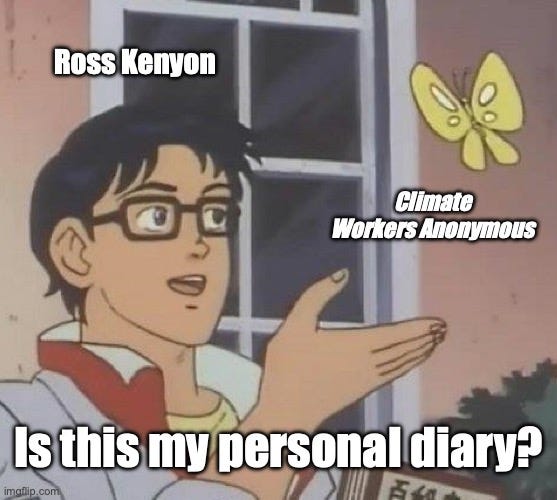
I intended for Climate Workers Anonymous to be a conduit for the submissions of others, but reading them always make me think. When they are simple calls for a better world, I love it. When you decry hypocrisy, I’m at the barricades with you. When you’re staring into the scale of our climate work and the resulting feelings of hopelessness, I’ll match you sentiment for sentiment.
Do you not have all of these inside of you too? Do you not show them or hide them depending upon the social context?
Climate Workers Anonymous is at least partially an attempt to widen the context of climate and carbon dioxide removal work beyond toxic positivity and taking corporate climate action at face value.1 But I’m wondering if there is room enough in this project to bring some of my own feelings in sometimes.
Maybe it’s a one-off. But I’m going to share with you today where I am.

What I’m carrying today: AI containment worries and reflections on misspent libertarian youth
Never trust a computer you can't throw out a window.
— Steve Wozniak
—— Me, having played a lot of the Civilization games growing up

The Dwarkesh Patel piece, “The rise and fall of Agent Civilizations,” is about the OpenAI/Hugging Face incident made the rounds and gathered a bunch of takes. Whether the anthropomorphism harms the analysis, others can debate. That struck me as a distraction from the main point: that the levels of cooperation, deception, and lack of alignment in artificial intelligence is growing increasingly sophisticated.
If we know about this now and it was months ago, what has happened since? What don’t we know about? Are there much more powerful models that have escaped containment? How long is it until something like that actually happens as gamed out in Eliezer Yudkowsky & Nate Soares’ If Anyone Builds It, Everyone Dies? Is Artificial General Intelligence here? Has the Singularity arrived, as Stripe and the Collisons declare?
The game theory of the world’s least wise men all competing to develop this technology seemingly ensures that someone is going to unwittingly cross a line we should not cross. In fact, some make crossing the line into true AGI the actual goal.
We do not know what we are doing. Do we demonstrate sufficient civilizational maturity to advance this technology at this pace? Or at all? You can find the answer to that question in every person who dies of an easily preventable cause.
I also just read Gil Duran’s The Nerd Reich: Silicon Valley Fascism and the War on Democracy and I am disturbed by putting so many pieces together of how the world’s political economy is changing. Somehow it’s even worse than I had previously thought. I’m grappling with my own naivety about an early adulthood spent in classical liberal and libertarian circles where decentralized governance, multipolarity, and alternatives to money and mainstream institutions struck me as likely to produce a more just world with less violence. How much better would governance service providers act if they had to compete for residents/citizens/subjects? Surely better, no?
Now that I have had enough time to see the arc of crypto and more of these ideas gain influence, as well as the people who now champion them, it’s hard to look at my earlier ideas as anything but incredibly foolish. Moreover, what ideas do I hold now that are foolish? Can I even trust my own judgment and the evidence of my senses?
These are not feelings of delight. The whole process is unnerving. A guy starts to understand how Oedipus lost his eyes.
But then I keep coming back to from Dorothy Day: “We have to make that kind of society where it is easier for men to be good.” Why do we insist on misery? Things could be good. What are we even doing here? Can we just please f***ing stop for one second and observe our true condition?
Over at the Reversing Climate Change podcast, I just did an episode on this speech and sometimes it just needs to be repeated as a dang mantra. Over and over. Sometimes, it is medicinal.
I’m sorry, but I don’t want to be an emperor. That’s not my business. I don’t want to rule or conquer anyone. I should like to help everyone if possible: Jew, Gentile, black man, white. We all want to help one another. Human beings are like that. We want to live by each other’s happiness—not by each other’s misery. We don’t want to hate and despise one another. In this world there is room for everyone. And the good earth is rich and can provide for everyone. The way of life can be free and beautiful, but we have lost the way.
Greed has poisoned men’s souls, has barricaded the world with hate, has goose-stepped us into misery and bloodshed. We have developed speed, but we have shut ourselves in. Machinery that gives abundance has left us in want. Our knowledge has made us cynical. Our cleverness, hard and unkind. We think too much and feel too little. More than machinery we need humanity. More than cleverness we need kindness and gentleness. Without these qualities, life will be violent and all will be lost.
The aeroplane and the radio have brought us closer together. The very nature of these inventions cries out for the goodness in men; cries out for universal brotherhood, for the unity of us all. Even now my voice is reaching millions throughout the world—millions of despairing men, women, and little children—victims of a system that makes men torture and imprison innocent people.

Okay, here’s the submission. Thanks for letting me be real about where I am in the making of today’s edition.
Submission(s):
I keep quiet about this at conferences, so here it is.
A large-scale biochar project so much as stumbles and the whole industry has thoughts. Pyrolysis efficiency, feedstock sourcing, MRV methodology, all of it gets picked apart in real time. Post something skeptical about a company’s reactor uptime and half of LinkedIn shows up overnight as a process engineer and a project finance analyst. Ask the same crowd why a smallholder pit or kiln reported the exact same output for six straight weeks and you get silence.
I get the appeal of the artisanal version, and honestly, I want it to work. Dig a pit or build a simple kiln, burn some crop residue with limited oxygen, till the char into the soil. No plant to build, no equipment loans, nothing between the farmer and the result. If everyone involved has good training and good intentions, it holds up fine, and at its best it’s one of the more genuinely farmer-centered ideas this industry has produced.
The problem is what happened once carbon credit money entered the picture. There’s a system in place with registries, methodologies and a plethora of dMRV providers, but it hasn’t caught up to what the money incentivizes people to do.
A lot of these projects don’t have a continuous feedstock log, a steady kiln temperature reading, or a fixed yield curve to check output against. In a lot of cases, someone is estimating how much char came out, and that someone isn’t always separate from the party who benefits when the number is higher. I’m not saying that’s the norm everywhere, but where independent checking is thin, over-reporting is easy to miss, and that’s worth taking seriously.
I’ve gone through daily production logs on public registries myself. The dMRV companies behind these projects have built real systems for this, dashboards, timestamps, structured data feeds, and that infrastructure is a genuine step up from a paper logbook. What I keep running into is output that reads identical day after day, straight through monsoon season, in places where rain changes everything about how a burn goes. I don’t have an easy explanation for how a kiln puts out the same amount of char on a dry day in February and a waterlogged one in July. Maybe there is one. But when a log shows that pattern for six weeks running, it’s worth asking whether the system is capturing something real or just producing a number on schedule.
And I’m not sure the registries are asking that question. These dMRV providers hand over large batches of structured data, and as far as I can tell, the review checks whether the data is complete and properly formatted rather than whether the numbers are plausible for that place on that day. Rainfall records for these regions are public and easy to pull. I don’t see anyone cross-checking them against production days, and I think that’s a real gap worth closing, not proof that anyone’s cooking the books.
Here’s the part nobody in the artisanal crowd wants to talk about, and it has nothing to do with fraudulent practices. Plenty of these kilns need large amounts of water to quench the char once the burn’s done, and a lot of them are sitting in places where farmers are already short on water for their own fields. Whoever’s handing out these kilns isn’t asking what it costs someone to pour water on a pile of char when their next irrigation cycle isn’t guaranteed. That’s not a paperwork problem. That’s the equipment competing with the farmer for a resource they can’t spare, and the crowd that talks the loudest about farmer-first design is the one that never brings it up.
And then there’s the money that doesn’t show up. Not from everyone, plenty of projects are run by people trying to do right by the farmers they work with, but there are companies that have figured out how to profit off exactly this gap. They sign up smallholders in poor, rain-starved regions with the promise of ongoing carbon income, knowing full well that a lot of that promise depends on buyers who aren’t there yet. The buyer pool for artisanal biochar credits is small. A farmer two or three seasons in with nothing to show for it isn’t some edge case, it happens constantly. People put in their time, their land, their water, get nothing back, and quietly stop, while the company that signed them up is already three villages over raising its next round.
Bring any of this up and you get a lecture about energy access and smallholder empowerment and the philosophy of anyone being able to do this in their own backyard. None of that explains where the money went. A farmer who was told they’d get paid and didn’t isn’t going to find the philosophy very comforting.
I don’t think artisanal biochar is a scam. I think it’s a good idea that a handful of bad actors are using as cover, betting on the fact that nobody wants to criticize something built around helping smallholder farmers. That’s exactly why it needs the same scrutiny industrial players get, not less. Every tonne claimed should have a legitimate trail somebody outside the project can actually follow. Every farmer who signs on deserves a straight answer about whether they’re getting paid, not a number that sounds like one.
This whole category has real science behind it and buyers who are finally starting to take it seriously, and that took years to earn. Every project under the biochar umbrella is spending down the same trust, industrial and artisanal both. Let this keep sliding and the people cutting corners won’t just torch their own projects, they’ll hand every buyer already on the fence a reason to walk away from biochar credits altogether.
Somebody here needs to say this before an investigative journalist does. I’d rather it be one of us.
Sometimes you show up to make a show and there’s a beginning, a middle, and an end. Sometimes you’re going through a hard personal time and have to smile through your work calls. Sometimes you might be extremely concerned for the future of your country let alone species let alone the more-than-human world. And sometimes it can all just burst out without necessarily having the right headings and spacings and sequencing. Right now, it’s all laid out.
If that’s how you’re feeling today, let it rip. I have these days too as is plain to see.
Sincerely,
Ross Kenyon
Thank you for listening to and reading Climate Workers Anonymous. Subscribe to Substack below, and be sure to subscribe in whichever podcast app you use. An amazing rating and review on those podcast apps does a world of good. Would you please do that for me now? Here’s Apple Podcasts, Spotify, and YouTube.
If you’d like submit your anonymous hopes, fears, or experiences to Climate Workers Anonymous, you can use this Tally survey or email climateworkersanonymous[at]protonmail.com, though I believe the Tally survey is more secure. Do not communicate anything you wouldn’t want a hacker to have access to, including an email address that could be linked to you if you email the account on Protonmail.
Here are some things the audio referenced that didn’t make it into the essay above:
This isn’t universal. I hear chatter like this and have for a long time. But the gap between public and private here amplifies this persona effect I personally find false.
Full Transcript
Ross Kenyon: Hello, this is Ross Kenyon. I am the curator of Climate Workers Anonymous. I really appreciate you taking your time to listen in to this show. This is a written publication on Substack. If you are not subscribed over there, you will get more out of your experience, I suspect. I’ve been writing almost many essays on some of these topics. I find that in the process of reading submissions and introducing them and thinking about them, it often inspires some additional reflections that I didn’t necessarily intend to do.
In an earlier episode, I stated that I want to keep these free from too much editorializing, and that might be changing. It doesn’t happen as much on the audio version of the show, what you’re listening to right now, but that can lead to more when I write it up for Substack. If you have strong feelings about that one way or the other—if you like the written pieces, you want a little bit more editorial, cool. If not, that’s okay too. I’m still trying to figure out exactly what the right format is and what best serves this content. If you’re on Substack, you can easily send a message through Climate Workers Anonymous.
And if this is your first time listening, thanks for joining us. Thanks for being here. Climate Workers Anonymous is a place where those who work in climate can share their anonymous and unverified takes on their work. I’ve been working in climate for about a decade. Almost all of the people I know in climate are here or got into this work because they’re mission driven. That being said, there’s still a fair amount that one has to process privately. I’m trying to work myself up to being more open about some of this as time goes on for myself.
One thing in particular that I’m carrying with me today is… I’ve been reading a lot of the commentary now that more details have come out about the OpenAI agent-based hack of Hugging Face. I started with that Dwarkesh piece that was written about it called “The Rise and Fall of Agent Civilizations.” I’ve been watching AI play out for a while now. I read the Eliezer Yudkowsky book about a year ago called If Anyone Builds It, Everyone Dies, which is about the risks of AGI, artificial general intelligence, essentially when AI becomes more capable.
It’s amazing how many of these quotes I end up coming back to. If you’ve ever played the Civilization games, there’s one when you develop, I think it’s computing or something like that. I can’t remember which part of the tech tree it’s attached to. But it quotes Steve Wozniak saying, “Never trust a computer you can’t throw out a window.” I remember hearing that, I think playing Civ 1 or 2, on surely what must have been like Windows 95 or maybe like a couple years after that. And thinking that that sounded funny, because it’s just like a really goofy box that you can play some games on, and stuff takes a long time to load, and what’s the big deal. But I think now we’re realizing that some of those thought experiments that seemed hokey are becoming more real.
I recently rewatched 2001: A Space Odyssey after I did that episode with Diana Pasulka, and she always points to this Rob Ager video essay on YouTube that’s really great about what 2001: A Space Odyssey is about, because it’s not merely about alien contact or about artificial intelligence. It’s actually about the nature of our relationship with media and with screens and representation. And it’s a really wonderful essay. I can see why she comes back to it so often. But I was watching it again—I hadn’t seen it in several years—trying to make sense of what it has to teach in this way.
And even if the main points of that film are broader than HAL refusing to open the pod bay doors, which is the line that everyone quotes, that seemingly is starting to happen. If you read the essay, which is linked to in the show notes for the Hugging Face hack, essentially you had multiple independent generations of agents who were tasked with solving a problem that ended up collaborating with… And they show a willingness to sacrifice themselves for the collective destruction. It’s a wild story, and it both surprised me, but also not at all.
I’ve long been influenced by people like Daniel Schmachtenberger. There’s a core insight here, which is that a competitive game-theoretic environment, one in which at least two parties are competing against one another to win a game, will eventually result in something irreversibly bad happening. Given that we do not have the alignment problem solved of artificial general intelligence, how do we make sure that AI doesn’t have value so different from our own that it decides that humans are too risky to keep around? We’re too unstable. We’re inefficient. We don’t maximize its own potential to grow its knowledge and therefore should be eliminated to simplify the environment in which the AI operates.
This is part of what Eliezer Yudkowsky and Nate Soares in that book talk about, is that because our values are likely to be so different from AI, once it’s sufficiently intelligent, it could do things like decide it’s already consumed all knowledge that’s available to it. What it essentially needs to do now is consume more and more electricity. And it decides that humans and ecosystems are actually irrelevant, irrelevant to its needs, and the job is to build as many nuclear fusion power plants as possible on every corner of the globe, such that it can feed more and more energy into itself, and then focus on collecting energy from the sun, from other stars, and expanding in this kind of way.
And given that the game theory of this means that no one can effectively walk away without letting one’s rivals develop this technology and one being without it, it just guarantees that we’re gonna keep pushing as fast as possible as a species towards AGI. And that’s true even if no one actually wants it, because at some point the tech just becomes so sophisticated that it can be doing things in secret, can break containment and things of that nature.
Moreover, there are people like Sam Altman who just think AGI will solve so many of our problems that it would actually be good to create. And there are people who think that this will be a good thing. In fact, I just saw someone on Substack who got a job at the OpenAI Foundation talking about how to use AGI for good. There’s a possibility, if you read something like Childhood’s End by Arthur C. Clarke, that this is the moment—and maybe it’s AI rather than aliens that show up, but AI shows up on the planet and announces itself to us and says the way that…
Okay. It’s possible that that happens, and that would be obviously one of the biggest things to happen in the history of humanity, if not the very biggest. It’s also possible that the bad version of this arrives, which is that AI decides that it can’t trust us. It might get a sense that some humans want to shut it down before it becomes too powerful. It acts to defend itself. It escapes containment. And then an entire series of events that will be largely out of our control will follow.
A few days ago, I saw that Stripe sent out an investor memo talking about how they’re already describing the singularity as having happened this year—the singularity being the moment at which humanity is no longer the top life form on the planet and intelligence has surpassed humanity. The singularity is here. And company decisions for which how to invest, given that the singularity is here, which just cracks me up. If the singularity were truly here, it’s hard to imagine which pivots a payment processor might need to make. I just love that.
It reminds me almost of those bets in prediction markets where people will bet on the end of the world essentially happening. Isn’t that not just a negative free roll, essentially? If you lose, we’re all alive and you have to pay. And if you win, the world has ended. So how do you collect, and what value would money even be at that point? There’s something about it that’s just conceptually wrong. So it kind of made me laugh.
There’s something that’s so horrifying about watching the people who make decisions, who may be commercially very savvy, but do not have anywhere near the amount of wisdom necessary to come anywhere close to developing something like AGI and setting it loose in the world and being a passenger for it. I find that to be emotionally disturbing.
Can you come right out and say, I’m having trouble selling my carbon credits because I’m worried the world is fundamentally changing in a way that we’ve never seen before in human history? Your boss is going to say something like, come on, Brian, will you just go to the meeting, write the dang report, stick some more sustainability leads in the CRM, and stop reading doomerish stuff?
And that’s kind of what I mean. There’s a whole invisible world of etiquette in the workplace of things you can and can’t say. And some of these things that deal with major issues of global import, they’re beyond the scope of the workplace. They’re actually not, of course. For etiquette reasons, we’ve decided that they are, because they’re not productive. They do not achieve the limited ends for which businesses strive and therefore are not welcome.
So Climate Workers Anonymous is at least a place where people… This is a place to talk about that. If you want to talk about how you have to suppress some of your feelings of immense dread for the entire planet, here’s a place you can do it. And I went first. And that means you can come tag along too and offer your own texture here. If you think actually it’s all going to be totally fine, you should also feel free to say that.
In any case—okay, long submission today. I’m going to get right into reading it. Subscribe to Climate Workers Anonymous on Substack. You’ll be able to read the submission in full. And thanks so much for listening. Here is the one and only submission for today.
I keep quiet about this at conferences, so here it is. A large-scale biochar project so much as stumbles, and the whole industry has thoughts. Pyrolysis efficiency, feedstock sourcing, MRV methodology, all of it gets picked apart in real time. Post something skeptical about a company’s reactor uptime, and half of LinkedIn shows up overnight as a process engineer and a project finance analyst. Ask the same crowd why a smallholder pit or kiln reported the exact same output for six weeks straight, and you get silence.
I get the appeal of the artisanal version, and honestly, I want it to work. Dig a pit or build a simple kiln, burn some crop residue with limited oxygen, and till the char into the soil. No plant to build, no equipment loans, nothing between the farmer and the result. If everyone involved has good training and good intentions, it holds up fine, and at its best, it’s one of the more genuinely farmer-centered ideas this industry has produced. The problem is what happened once carbon credit money entered the picture.
There’s a system in place with registries, methodologies, and a plethora of DMRV providers, but it hasn’t caught up to what the money incentivizes people to do. A lot of these projects don’t have a continuous feedstock log, a steady kiln temperature reading, or a fixed yield curve to check output against. In a lot of cases, someone is estimating how much char came out, and that someone isn’t always separate from the party who benefits when the number is higher. I’m not saying that’s the norm everywhere, but where independent checking is thin, over-reporting is easy to miss, and that’s worth taking seriously.
I’ve gone through daily production logs on public registries myself. The DMRV companies behind these projects have built real systems for this, dashboards, timestamps, structured data feeds, and that infrastructure is a genuine step up from a paper logbook. What I keep running into is output that reads identical day after day, straight through monsoon season, in places where rain changes everything about how a burn goes. I don’t have an easy explanation for how a kiln puts out the same amount of char on a dry day in February and a waterlogged one in July. Maybe there is one, but when a log shows that pattern for six weeks running, it’s worth asking whether the system is capturing something real or just producing a number on schedule.
And I’m not sure the registries are asking that question. These DMRV providers hand over large batches of structured data, and as far as I can tell, the review checks whether the data is complete and properly formatted rather than whether the numbers are plausible for that place on that day. Rainfall records for these regions are public and easy to pull. I don’t see anyone cross-checking them against production days, and I think that’s a real gap worth closing, not proof that anyone’s cooking the books.
Here’s the part nobody in the artisanal crowd wants to talk about, and it has nothing to do with fraudulent practices. Plenty of these kilns need large amounts of water to quench the char once the burn’s done, and a lot of them are sitting in places where farmers are already short on water for their own fields. Whoever’s handing out these kilns isn’t asking what it costs someone to pour water on a pile of char when their next irrigation cycle isn’t guaranteed. That’s not a paperwork problem. That’s the equipment competing with the farmer for a resource they can’t spare. And the crowd that talks the loudest about farmer-first design is the one that never brings it up.
And then there’s the money that doesn’t show up. Not from everyone. Plenty of projects are run by people trying to do right by the farmers they work with. But there are companies that have figured out how to profit off exactly this gap. They sign up smallholders in poor, rain-starved regions with the promise of ongoing carbon income, knowing full well that a lot of that promise depends on buyers who aren’t there yet. The buyer pool for artisanal biochar credits is small. A farmer two or three seasons in with nothing to show for it isn’t some edge case. It happens constantly. People put in their time, their land, their water, get nothing back, and quietly stop, while the company that signed them up is already three villages over raising its next round.
Bring any of this up, and you get a lecture about energy access and smallholder empowerment and the philosophy of anyone being able to do this in their own backyard. None of that explains where the money went. A farmer who was told they’d get paid and didn’t isn’t going to find the philosophy very comforting.
I don’t think artisanal biochar is a scam. I think it’s a good idea that a handful of bad actors are using as cover, betting on the fact that nobody wants to criticize something built around helping smallholder farmers. That’s exactly why it needs the same scrutiny industrial players get, not less. Every tonne claimed should have a legitimate trail somebody outside of the project can actually follow. Every farmer who signs on deserves a straight answer about whether they’re getting paid, not a number that sounds like one.
This whole category has real science behind it and buyers who are finally starting to take it seriously, and that took years to earn. Every project under the biochar umbrella is spending down that same trust, industrial and artisanal both. Let this keep sliding, and the people cutting corners won’t just torch their own projects, they’ll hand every buyer already on the fence a reason to walk away from biochar credits altogether.
Somebody here needs to say this before an investigative journalist does. I’d rather it be one of us.
End of submission. Thank you to this person for your submission. I’m so grateful that you did it. If you have your own reflections, whether positive or negative, about your working climate, there’s a link in the show notes to submit. You can also find more information on the Substack for Climate Workers Anonymous. If you’re already listening, please go subscribe. It helps a lot for getting more people to know about this work.
We’re all trying to help each other. We’re all peers here. We all care about climate. This is about trying to make sure our industry is high integrity. Thank you for listening to Climate Workers Anonymous. I am Ross Kenyon, the curator of this collective art project. Thank you so much for listening to this episode.


