



Welcome to Climate Workers Anonymous, where those working in climate share their anonymous and unverified experiences, feelings, and analysis about their labor.
Today’s show has submissions covering both the highs and the lows. But even in saying that, I wonder if I start to cross my own editorial standards that I discuss in the podcast version of this episode.
Someone left a review on Apple Podcasts that made me think—should I be commenting upon the submissions? So far I haven’t been. I’ve been publishing them and letting them stand on their own. I worry that if I say too much I might misinterpret, or point people away from their intended meaning. Or, potentially worse, distract from their truth with my own commentary.
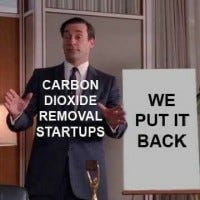
One of the other creative projects I work on is Carbon Removal Memes. It’s biggest on LinkedIn but starting to stand it up on Substack. I started it and built a writer’s room while at my previous company, Nori. It continues on with a rotating cast of meme writers where we workshop our pitches.
While I do occasionally have to reign in an editorial take on an issue I think is beyond what is supportable, I mostly try to help people find their funny. I’m not trying to grind my own ax more than theirs. Even if I don’t connect with something they made, if they find it funny and stick up for it, I’m willing to give it a shot. If it connects with them, it will likely connect with someone else.
It’s one of the few rules of making art that I know of—if you don’t like what you made, it’s unclear who else will. Or at the very least, you will be unable to tell if it is good or not unless someone tells you. That is a difficult aesthetic position to be in.
And while I don’t agree with the editorial line every meme takes, I don’t view it as my role to be the final arbiter of truth. My job is to help others express themselves and make work of which they are proud.
That ethos has also prepared me for Climate Workers Anonymous. These are unverified takes people send in. I’m not checking for corroborating sources. This is impressionistic; not journalistic. My work here is to enable others to create and share what they have experienced as true. That leads me to think I should minimize the amount of direct commentary on post submissions.
If you think I’ve made a wrong turn, feel free to comment or send a message. I’m still figuring this out and I want it to be the best version of itself that we can make it.
Submissions
I get incredibly frustrated listening to industry experts and scientists because they are among the worst communicators.
Coming from the healthcare space there are very few absolutes when talking about scientific intervention. Both industries like to go on and on explaining nuance, trade offs, unintended side effects, and all through the well intended belief that people should make informed decisions.
In reality the important go/no-go decisions are made because of well thought out marketing campaigns, tribal dynamics, and incentives.
If carbon removal is going to be taken seriously we need to bring in the worlds best communicators who aren't just posting on Linkedin. They need to be out in the real world finding ways to connect this to peoples everyday lives.The climate companies I worked at were, hands down, the most toxic cultures I experienced in 15+ years. It feels like the previous gold rush in climate tech funding (RIP) attracted really narcissistic personalities, even by tech founder standards. Some of those "impact tech founders" have now pivoted into AI; follow the money, I guess.
I'm much more content now day to day after switching into working on a climate-adjacent topic that doesn't self-glorify the way carbon companies did. I'm working on something that helps real people. However, I still get a front row seat to how close to collapse our systems are. And I struggle with guilt about having participated in what I now consider to be greenwashing efforts.
I used to be way more technocratically optimistic. Unfortunately these experiences have convinced me we are truly f*cked. The private sector seemed like the only front of the war where things were moving for awhile & now I have no faith. Everyone's in AI psychosis and staying really busy in the remaining normal years we have left, while our governments enable crazy men extracting whatever we have left before their bunkers are ready.
Whereas it used to feel powerful to be driving these topics in the tech economy, it now feels taboo. Overall I feel incredibly lonely; there are very few people (just a couple friends and former colleagues) who I can talk to about this stuff openly.I may be more group therapy-ing here than confessing. But forgive me nonetheless. Also I did dictate to and then put it through an LLM in an attempt to anonymise it a little more (which I would argue is a fair use of an LLM, by the way).
So:
I increasingly think that in the work of carbon removal, of climate action, and of tending the wider bounds of this Earth, that we must keep faith with people.
Faith with humanity.
It is easy to lose it. One looks upon many institutions, upon quite a few ‘fashionable’ organisations, upon some leaders of the hour, strutting and fretting their brief turn upon the world stage.
One often sees ignorance, vanity, fear short reckonings, and the cold arithmetic of the zero-sum game. One sees much that would invite despair.
Yet as the years pass, I find myself believing the opposite about my fellow Homo sapiens.
I think these harmful behaviours - vivid and gravels they can seem, are not the rule, but the exception.
The rule is that most people are decent.
As Rutger Bregman and others have written, the true tale of humanity is often not the one we tell. The real Lord of the Flies (and I recommended looking up the real Lord of the flies) is not a descent into savagery, but people cast ashore who learn to help one another. They quarrel. They disagree. They grow angry and must walk apart for a while. Then they return and speak again.
They resolve things, they heal, they carry on together.
The cruel person, the sociopath, the one whom old myths would call wicked, is rarer than we think. They command attention because they are loud. And because, annoyingly, they still seem a bit too good at getting into positions of power. But they are not the multitude.
I could offer many examples from my own brief passage upon this Earth, but I shall leave you with one.
For a time I volunteered as a musician at my church. Between songs, we would stand at the back and listen to the sermon. One day I found myself and my band mates off to the side near a water point.
There was a young girl, seven or eight years of age. She kept coming to fill up cups of water, and then go back and give them to other children and parents in the kids areas. It was such a small yet immeasurably kind act. Nothing remarkable, perhaps, except that it was.
Later I learned that she and her siblings were refugees. I learned also that she was being bullied at school.
I can take care of myself, and these days my heart can often feel quite hardened. But I still feel very moved thinking about that vivid example - and frankly many tens of thousands of interactions I’ve now had with others that basically reflect that game-theoretic structure.
In my least-worst moments, I work to remember that the vast majorly of humankind would have once been like that little girl.
Even the hardest among us was once a child.
Even the ruthless executive. Even the cut-throat trader. The corrupt politician. Even the squanderer of tomorrow who spends the future as though it were petty cash.
Even the person who wounds others and, perhaps, themselves.
Chances are that once they, too, tried to be kind. Once they, too, desired only to belong. Once they, too, were a small child trying to bring some water to others.
I know this is not always so. There are dark things in the world. One of the great tasks of our age is to solve our problems of coordination and to help the collaborative, helping majority prevail over the predatory, harmful few.
Yet I believe with all my heart that most people, when given knowledge, opportunity, and agency, wish to help.
They wish to care for the carbon cycle and the climate. They wish to protect the living systems upon which all lives depend. They wish to leave a fairer inheritance than the one they received.
Give people the chance, and most will not turn away.
Give them the tools, and many will do beautiful things.
And when I am cynical, when I am frustrated, when I am feeling just so very tired and alone, I try to remember all this.
Then I try again to do my small part towards helping nurture a more safe and just future for all, and - where possible - reversing climate change.
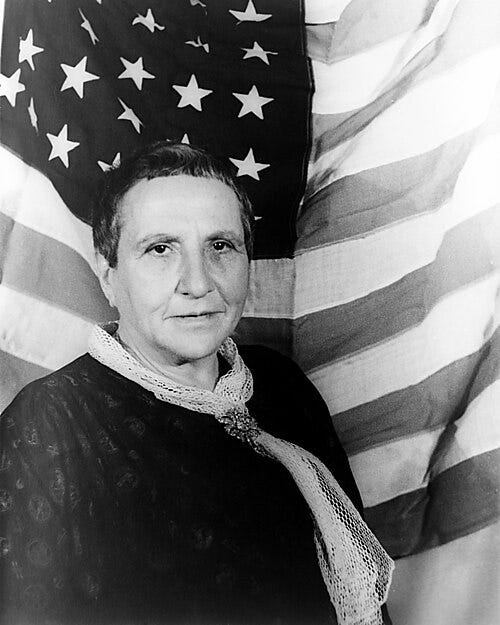
If you are truly a completist, here’s a link to Gertrude Stein.1 I am not sure if this is in fact an apt comparison, but it stands as a thought.
Thank you for listening to and reading Climate Workers Anonymous. Subscribe to Substack below, and be sure to subscribe in whichever podcast app you use. An amazing rating and review on those podcast apps does a world of good. Would you please do that for me now? Here’s Apple Podcasts, Spotify, and YouTube.
If you’d like submit your anonymous hopes, fears, or experiences to Climate Workers Anonymous, you can use this Tally survey or email climateworkersanonymous[at]protonmail.com, though I believe the Tally survey is more secure. Do not communicate anything you wouldn’t want a hacker to have access to, including an email address that could be linked to you if you email the account on Protonmail.
Thanks so much for reading and listening. I am glad you’re here.
Sincerely,
Ross Kenyon
Namechecking her sent me down a rabbit hole of her potentially being a Nazi collaborator during World War II.
Full Transcript
Ross Kenyon: Welcome to Climate Workers Anonymous. This is Ross Kenyon. I am the curator of this collective art project, paying homage to PostSecret, but for those who work in climate. In this show, people send in anonymous and unverified takes, experiences, feelings, hopes, fears about their work in climate, something that they might like to share, but also do not wish to be attributed to their name.
If you haven’t subscribed on your podcast app or on Substack, that would be much appreciated. A lot of the show is happening on Substack, so your support over there means a great deal. Rating the show, giving it a great review is also very much appreciated. If you’re able to do so, please open up your podcast app right now, whatever it is, write a positive review, give it a full rating, and thanks so much for your support.
I’m happy you’re here. I’m sure the people who are writing in also are happy that the things that are maybe a bit too painful to share out loud are being appreciated in the quiet over on this podcast and publication.
One quick reflection. I saw a review on Apple Podcasts that came out saying that they had wished I would comment on the submissions. And I’m trying to think my way through that. I’ve been presenting them and then letting them stand on their own for the most part. Maybe I have a reflection at the beginning of the show that relates in some way. But I’m also trying not to add too much editorial color to what other people are saying. I wonder if I add too much, will I take away from what others are trying to say? What if my interpretation of their words is not what they had meant to say? Somehow distorts it, ruins it. It’s also possible that I enhance it, but it’s also possible that maybe I missed the mark. I’m trying to think through exactly how that might go and what might be the right way to run that risk. Better to leave it starkly alone. Better to add some commentary. I’m going to think.
But as someone who has been making Reversing Climate Change, my other podcast project, for about a decade, I can be a little bit loquacious. And I’m trying to do things that are different. I feel like if I do something that’s too close to how I do things on Reversing Climate Change, maybe it will not be different enough to be viewed as a separate project. And I really do want them to be viewed as separate. While emotional topics come up on that show a lot, and if you haven’t heard it, you will almost certainly like it if you like Climate Workers Anonymous. I think the kind of person who likes one will likely like both, but Reversing Climate Change does have a fair amount of emotional shows, though it focuses more on cerebral, literary, philosophical, historical connections to carbon dioxide removal and climate change.
Whereas what’s happening in this show, I’m trying to keep it just real, emotionally grounded. Not a bunch of fancy footwork. Not trying to show off how many books I may or may not have read. Just being a proxy for the feelings of others that are maybe difficult to share.
And as I’m saying this, I’m realizing that this is also my role with Carbon Removal Memes, which if you haven’t seen, they’re also on Substack and I’m trying to stand it up over there. It’s mostly on LinkedIn at this point. They are memes about working in carbon dioxide removal and climate, climate tech. Some of them have some spicy hot takes in there. I don’t make every meme. People sometimes assume that, or they want to talk to me as though I do that, but there’s a writer’s room. And I try to make sure that whoever is making a meme, when we workshop it, I don’t necessarily run over them with my own editorial preference on is what they’re saying good or bad or ethical. Maybe sometimes I do if it gets close to that. I also want people to feel free to chase the funny wherever it goes. And if it’s true to them, it’s likely true to someone else, even if it’s not true to me.
And so the job of leading a writer’s room, curating, fostering a writer’s room, however we want to say it, or even just acting as a leader in those spaces is maybe more general, maybe the way that I prefer to say it, is you help others achieve their comedic vision without necessarily having to get your own fingerprints all over it. It’s the Gertrude Stein of meme making mentality. Actually, I think Gertrude Stein was probably a bit more involved with the Lost Generation writers. Now I need to go look that up. That’s probably not even correct.
So same for the memes. Sure, I think I’m the only one in the writer’s room, which is rotating, that has it on their LinkedIn profile. And that means that stuff can pass through me in a way that, I don’t know, if people have something that they want to say that maybe they’re a little bit scared to say, then okay. They’re not publicly affiliated. And same with this. I’m just a vehicle, a tool for supporting the comedic and emotional gifts others bestow upon the world, upon our industry. And maybe that’s a good way to say it.
So I think I’m going to abstain from too much commentary on individual submissions right now, because I’m trying to make space for others to really let it rip with how they see it. And I think I would feel bad if someone poured their heart into something and I riffed on it in a direction that somehow diminished the trust that they put into me and the show. So I’m probably going to keep it simple for now. I’ll keep thinking about it though.
And if you think I’ve made the wrong decision on this, you think I should turn back, you let me know. There’s a ProtonMail email address in the show notes. You can also just write into the Tally submission form for anonymous feedback. If you have feedback in any direction, feel free to let me know so I can make sure that this is a project that will keep you coming back for more.
Prologue over. Let’s get to the first submission.
Submission number one.
Ross reads the first submission in full at this point. It is the text of the post above, from “I get incredibly frustrated listening to industry experts and scientists” to “finding ways to connect this to people’s everyday lives.”
Submission number two.
Ross reads the second submission in full at this point. It is the text of the post above, from “The climate companies I worked at were, hands down, the most toxic cultures” to “who I can talk to about this stuff openly.”
Submission three.
Ross reads the third submission in full at this point. It is the text of the post above, from “I may be more group therapy-ing here than confessing” to “and—where possible—reversing climate change.”
Thanks so much for listening to Climate Workers Anonymous. If you enjoyed this show, please subscribe. Give this show a great rating and review in your podcast app. See you on Substack. Tell a friend about this. Post about it on LinkedIn or wherever you’re doing your social media.
Thanks so much for listening. I hope you were able to connect with at least one of these submissions today. And have a lovely day.


