



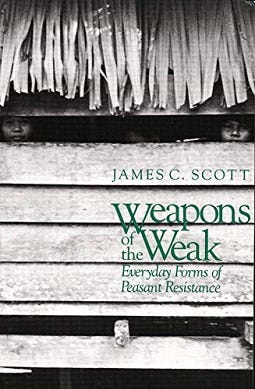
Today’s unverified and anonymous submission to Climate Workers Anonymous sent me into reflection about the work of anthropologist James C. Scott. Books of his like Weapons of the Weak: Everyday Forms of Peasant Resistance document how subaltern peoples (a very British and old way of saying “subordinate” that got reappropriated and used in academic literature related to this phenomenon) get their way without direct confrontation.
Is your adversary stronger than you? Better connected? Or just nastier? What if you pretended you were a fool and forgot a lot of things. What if you left your tools out so they rusted and you couldn’t work. What if you were or feigned illiteracy such that contracts could not be held to as written? Is it any surprised that trickster gods tend to be powerful and recurrent mythological figures in these communities?
What follows isn’t exactly like what James C. Scott studied, but it rhymes with it. Maybe one doesn’t necessarily need to invent the future, but merely to make the past very annoying for all involved? Now that’s a take that won’t get you into Y Combinator.

Here's this edition’s one and only anonymous and unverified submission that was sent in for me to read and publish:
Submission(s)
I am a termite, and the termites are winning.
I work on power grid connections for large emitters in a major developed country. I won’t say which, because i think praising them too loudly will undermine the underminers.
Over the last three years or so, the electricity regulator here has slowly been cutting off the routes to connect new oil and gas generators through minor changes to grid codes and guidances. Like termites, the authorities have eroded the support structures that gas-fired power plants rely on to get built.
It is now virtually impossible to build a new power plant in this country without CCS. It simply cannot be done. You can build the plant, sure, but you cannot connect it to the grid and sell power. There is no longer a business case. In my company, which builds these generators, this went unnoticed until it was already enforceable. Now, I get the pleasure of enforcing it all, and I love it. For these projects, it’s CCS or death.
What impresses me is that I am a low level employee, and the people modifying these grid codes are likely that as well. These are public servants with low salaries and long hours, and the majority are likely in the first decade of their careers. There is no valor here. Grid world is so complex that it’s effectively shielded from a lot of public awareness, and doesn’t get the same political attention as the generators themselves. While politicians in this country have a lot to say about the relative benefits of wind turbines and gas plants, they can’t engage at the level we work at in grid connections, because the informational bar of entry is too high. When I explain my job to friends, even academic ones working in sustainability, they struggle to understand. Listeners of this confession might honestly not understand. It’s not accessible to most, and this protects the termites from those who would stop them.
I don’t like my job very much. I was hired to work on renewables at a formerly pure-play oil and gas firm who stuck their toe into the energy transition. As the renewable projects dried up, my sense of purpose wore thin. It is difficult to work with older colleagues that in some ways sold my future out from under me for their own gain. But when I shifted from renewables to thermal generation projects, it was like I pulled up a floorboard and saw the entire foundation had already been eaten by termites.
The work is done for me. These regulations are terminal. All I have to do now is tell the projects that their business cases are unsound. Make this power plant run with CCS or there will be no power plant—I don’t make the rules. The termites did.
I had been carrying so much climate angst for the last years, but this is the realization I wanted to share with you: It often feels like we’re up against the richest men in history when it comes to working on climate change, and that we need a messianic figure to rise up to defeat them. It is not like this. The way that we win is by getting inside their machines and breaking them, by invading their structures of power and weakening them. If you feel like a bug compared to the likes of Musk, Bezos, and bin Salman, it’s because you are. Lean into this. Work for the regulators if you can. Small changes build up over time, and I see it working. I am a termite in the oil and gas sector, and there are termites in every government. Together we are legion.
Don’t give up!
Sometimes some well wishes from a fellow insect can be all one needs to buoy one’s spirits.
Thanks so much for writing in and for your support. Not to sound too much like a therapist’s website, but I’m glad you’re here.
Sincerely,
Ross Kenyon
Thank you for listening to and reading Climate Workers Anonymous. Subscribe to Substack below, and be sure to subscribe in whichever podcast app you use. An amazing rating and review on those podcast apps does a world of good. Would you please do that for me now? Here’s Apple Podcasts, Spotify, and YouTube.
If you’d like submit your anonymous hopes, fears, or experiences to Climate Workers Anonymous, you can use this Tally survey or email climateworkersanonymous[at]protonmail.com, though I believe the Tally survey is more secure. Do not communicate anything you wouldn’t want a hacker to have access to, including an email address that could be linked to you if you email the account on Protonmail.
If one person thinks something, ten or a hundred have had the same thought and said nothing. Go first.
Anonymous by design. No email field, no sign-in, and I read every submission aloud myself so nobody ever hears your voice.
Episode art adapted from a photograph by Olga Ernst, CC BY-SA 4.0, via Wikimedia Commons.
Full Transcript
Ross Kenyon: Hello. This is Ross Kenyon. I am the curator of Climate Workers Anonymous. Thanks for listening. If this is your first time here, welcome. This is like PostSecret, if you’re old enough to know what that is. When I was a teenager, PostSecret was a thing, and apparently it still lives on, where mostly depressed teenagers would decorate a postcard with an unsayable sentence and mail it in to be published anonymously.
There’s a lot of people who work in climate who tell me things in private or maybe just in small groups after the conference has ended at the bar afterwards, things that deserve to be said in the sober light of day, that really just cannot be said.
Most of them are about how different our work looks relative to what we imagined it would look like, how much compromise there is in trying to run a successful business whose customers are corporates who are not always very nice, who talk a big talk, but we all kinda know, they’re not really serious. Uh, some of them are. I think many of the people at organizations are, but by and large it’s just not a priority for individual companies to be worried about this. And that can sound like an indictment of capitalism, of corporate leadership, whatever.
You can take it that way. But it’s also just probably the wrong level of culpability and of action to be looking to to solve climate. Why do we have it in our heads that the way to solve climate change is to get companies to voluntarily buy carbon credits or to decarbonize in some other way?
At least partially, and this is not my original thought. I’ve seen, um… I’m trying to remember who pointed this out to me however long ago. But as I say this, it sounds like Slavoj Žižek, and maybe it is, but ideology functions at an invisible level. The things that become, quote-unquote, ideological are unexamined beliefs that structure reality.
The belief that we have in our head that corporations are the correct level to start at in order to address climate change rests on an ideology that government is mostly distant, unresponsive, slow. The people who work there couldn’t get a job that pays more doing something more important in the private sector. And therefore the way to get action is to go to private markets and private organizations and start working that way.
There are absolutely places where that is true. I’m not saying that that’s even a wrong thought. I think if one has been inside of the wrong or the right government office in whichever country you had to do something, and you’ve noticed that, uh, they sent you to another office and it just so happens to be the office that you came from, where you had to cry to the clerk saying, “Why does this form not work? I had everything notarized and apostilled,” and they send you away anyways, and maybe it only works if your cousin calls and they know the supervisor of that department, and then, “Oh, we found your records here. Actually, you don’t need to go anywhere else.” There are some places where the world does work like that, and if that’s your experience, then it would feel like the only alternative is a private company approach, the voluntary carbon market, something like that.
But one thing to consider is that at least in the US, many of these services do not have adequate staff or technology to do their tasks super well. We cut their funding and then complain when they don’t work very well. So we often have an experience of some of these offices that are grim. But if you go someplace like Estonia, it isn’t grim. Well, no more than it is being grim because it’s Northern Europe and, uh, culturally it’s a little different from the United States maybe.
And I think just being able to point to why we’re in this position where we have to serve corporates and how that distorts how we’re able to talk about climate is really important. That being said, it’s getting this way for serving at a policy level too. For instance, if you’re applying for various federal grants right now, one would be wise to omit the climate benefits one provides. Government used to have a bit more neutrality to it.
It doesn’t always, though, and there are downsides, too, to having this apolitical, administrative functionary class in government. The bureaucrat whose job is just to make sure things are done according to a strict procedure without a broader sense of justice or what their work is meant to achieve beyond the confines that are admittedly quite limited. It isn’t necessarily in that person’s interest or society’s interest to have that always either. There are trade-offs with these things. I’m happy to explore how political or apolitical we should strive to make administrative law and those tasked with carrying it out. I think that’s a really interesting philosophical and empirical question.
The thing is, it’s often pretty hard to even ask these questions, especially if they pertain to the corporates that one is mostly serving in carbon markets and carbon dioxide removal right now in the cold light of day, because one will just look risky to any of the possible customers. Is this person going to criticize me in public after I give them a major contract that saves their dinky little startup from obscurity and likely death? That’s an easy reason to say no to a mouthy carbon dioxide removal project developer.
And that’s why we are here for Climate Workers Anonymous. If you have something that you wanna say that you just can’t for any of those reasons, if you can’t even ask a question because asking that question looks impertinent or risky when you need to just look like a boring functionary. “Oh, I don’t need to think about the bigger questions of how CDR works and how carbon credit markets work. I just need to make sure that the credits leave the door and get sold. What happens outside of that context, that’s someone else’s job. That’s above my pay grade.” Guess what? It’s not above your pay grade. You are responsible for your actions. It’s unclear where that responsibility ends, how many second, third, fourth order effects do you need to consider to be ethical, but let’s just say this is a place to ask impertinent questions about your own ethics and your own responsibilities. And we can do that without having to attribute anything.
So if you have a take about your work in climate, which can be exactly as I described, or if you’re somehow still really hopeful about what’s happening in climate and carbon markets and carbon dioxide removal, you can share that too. Last week, there was a… It was last week or two weeks ago, there was one that was very optimistic that was saying that things are really good. But it’s hard to share that with anyone and how lonely that feels. That’s a good take. You don’t have to just come in here with your polished left-wing corporate criticism. Come on out and tell me something that you’d like to say, but you think it’s not going to help you personally to say it attributed to your own name.
The downside of this is that these takes are unverified, and I can’t chase down the truth of individual criticisms of companies, and that’s just not what this project is about. I’m trying to find a way to make it so that if that’s what you wanna do and what you need, uh, in order to serve your conscience, I can point people like this in a specific direction. I don’t have it yet, but I am thinking about it.
I suspect there are people listening that have things that they want to share that go beyond just the feelings of working on climate in a deeply compromised world. That’s a different problem. Unfortunately, I think that’s the only one I can help you with because I’m very much in that same position. If it goes beyond that, it’s really not what I’m trying to do or even what I can responsibly do.
Today I have a take, a submission if you will, and I haven’t seen one quite like this just yet, but I’m really interested to share it with you. Lately, I’ve been doing these one and done, so today the only submission, submission one begins now.
I am a termite, and the termites are winning. I work on power grid connections for large emitters in a major developed country. I won’t say which because I think praising them too loudly will undermine the underminers. Over the last three years or so, the electricity regulator here has slowly been cutting off the routes to connect new oil and gas generators through minor changes to grid codes and guidances. Like termites, the authorities have eroded the support structures that gas-fired power plants rely on to get built.
It is now virtually impossible to build a new power plant in this country without CCS, carbon capture and storage. It simply cannot be done. You can build the plant, sure, but you cannot connect it to the grid and sell power. There is no longer a business case. In my company, which builds these generators, this went unnoticed until it was already enforceable. Now I get the pleasure of enforcing it all, and I love it. For these projects, it’s CCS or death.
What impresses me is that I am a low-level employee, and the people modifying these grid codes are likely that as well. These are public servants with low salaries and long hours, and the majority are likely in the first decade of their careers. There is no valor here. Grid world is so complex that it’s effectively shielded from a lot of public awareness and doesn’t get the same political attention as the generators themselves. While politicians in this country have a lot to say about the relative benefits of wind turbines and gas plants, they can’t engage at the level we work at in grid connections because the informational bar of entry is too high.
When I explain my job to friends, even academic ones working in sustainability, they struggle to understand. Listeners of this confession might honestly not understand. It’s not accessible to most, and this protects the termites from those who would stop them.
I don’t like my job very much. I was hired to work on renewables at a formerly pure-play oil and gas firm who stuck their toe into the energy transition. As the renewable projects dried up, my sense of purpose wore thin. It is difficult to work with older colleagues that in some ways sold my future out from under me for their own gain.
But when I shifted from renewables to thermal generation projects, it was like I pulled up a floorboard and saw the entire foundation had already been eaten by termites. The work is done for me. These regulations are terminal. All I have to do now is tell the projects that their business cases are unsound. Make this power plant run with CCS, or there will be no power plant. I don’t make the rules. The termites did.
I had been carrying so much climate angst for the last years, but this is the realization I wanted to share with you. It often feels like we’re up against the richest men in history when it comes to working on climate change, and that we need a messianic figure to rise up to defeat them. It is not like this. The way that we win is by getting inside their machines and breaking them, by invading their structures of power and weakening them. If you feel like a bug compared to the likes of Musk, Bezos, and bin Salman, it’s because you are. Lean into this. Work for the regulators if you can.
Small changes build up over time, and I see it working. I am a termite in the oil and gas sector, and there are termites in every government. Together, we are legion. Don’t give up.
End of submission.
If you’re listening and you have a story about being a termite, you feel some affection for this story, go ahead and write in. In the show notes or on Substack or both, there’s a Tally form where you can submit your confession, your story, however you wanna frame it. There’s also an email address, although an email address requires some extra steps to be sufficiently anonymizing.
Send me something I can read that will make someone think. Maybe you have a thought that you’ve never heard anyone say out loud. You know, if one person thinks something, 10 or 100 have almost certainly had that same thought. That’s leadership.
Someone might have just heard this and think, “Holy crap, I’m a termite and I never even realized it.” That’s a really valuable thing that you’re doing. Just saying that can create some fellow feeling that people didn’t even know that they were missing. They thought they were alone. Maybe someone out there no longer feels as alone. And that’s a big part of why PostSecret was so great, and also why I like doing this project.
Most of this work is happening on Substack. If you could follow the links and subscribe over there, it’s really helpful for the show.
Thanks for listening. I’m trying to do this every week. I can’t guarantee it’s gonna come out every week, but I’m trying for every Tuesday. Thank you so much to all of the submitters. If I haven’t gotten to you yet, it’s in the queue. Thanks for doing so, and thanks for being brave and sharing your true thoughts. I know it’s hard. Some of these thoughts are hard to acknowledge even to oneself. Those are the hardest ones. I think even saying things anonymously can give one some courage. Take that courage with you today into your climate work.
Thank you for listening to and/or reading Climate Workers Anonymous. This is the curator of Climate Workers Anonymous, Ross Kenyon. And I hope you have a great day with whatever it is that you aim to do. Bye for now.


